
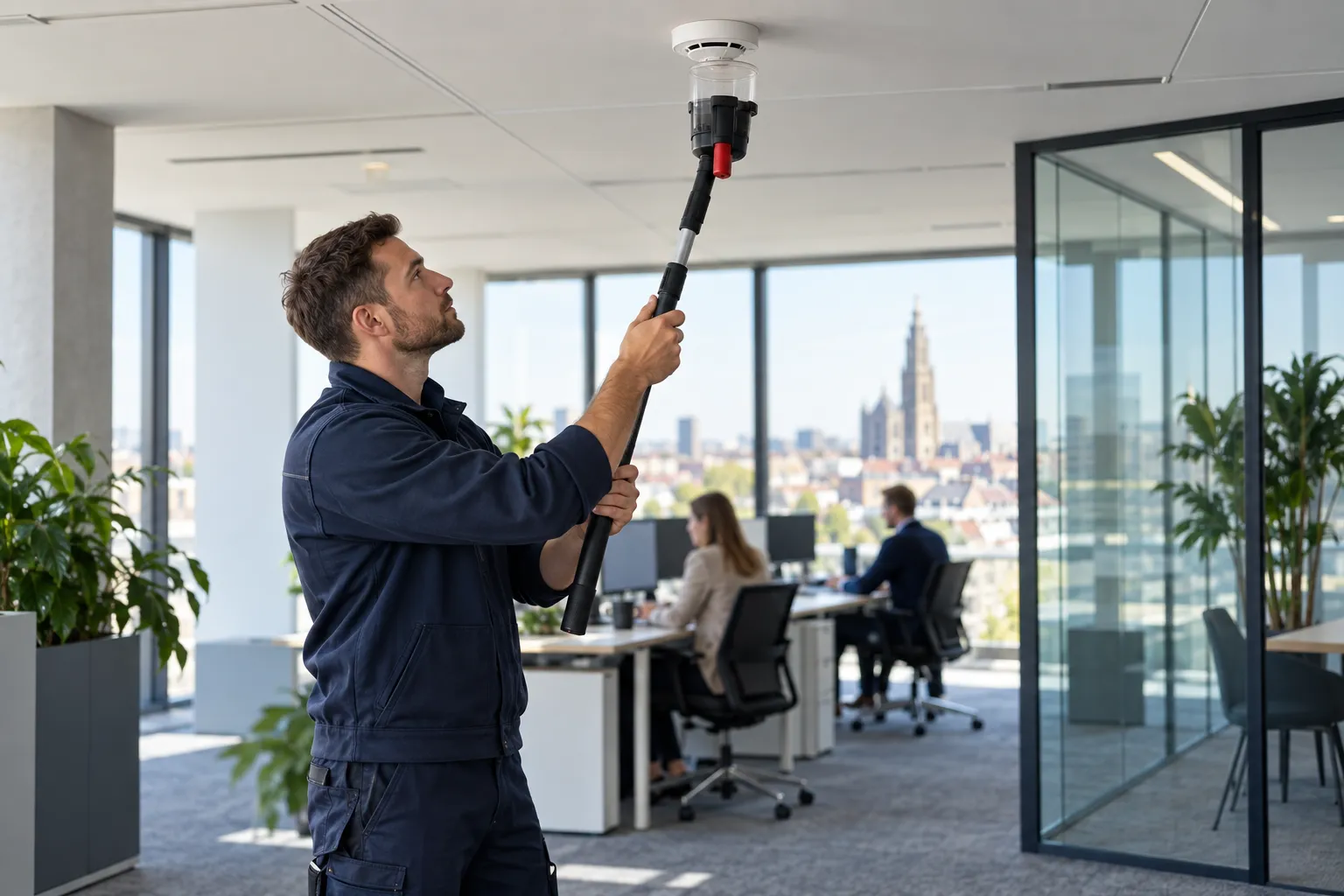
Employers must assess fire risk and take material and organisational measures to prevent fire, evacuate people safely, fight an incipient fire, limit effects and support emergency services. Detection requirements flow from that assessment and site rules.
Key points
- Begin with risk scenarios, not a detector.
- Building, activity and people shape measures.
- Detection, evacuation, access and organisation must align.
- Records, drills and maintenance are part of the system.
Regulatory content reviewed on 8 September 2026. Check official sources for your specific situation.
What the Code requires
Book III, Title 3 requires a fire risk assessment covering fuel, ignition, equipment, activity, size, people, vulnerable groups, rooms and external companies.
Employers identify scenarios and adopt measures for prevention, evacuation, early firefighting, mitigation and emergency response.
- Activity
- People
- Rooms
- Substances
- Contractors
- Spread
No universal kit
An office, workshop, warehouse, school and care facility have different scenarios. One detector count cannot fit all.
The assessment may lead to automatic detection, manual points, evacuation signalling, compartmentation and procedures. Local or sector rules may add requirements.
| Factor | Possible effect |
|---|---|
| Occupancy | Detection and evacuation |
| Volume | Technology and siting |
| Dust or steam | Nuisance alarms |
| Vulnerable people | Signalling and help |
| Continuous use | Work phasing |
Scenario before architecture
For each zone, identify likely origin, detectable phenomenon, occupants, information path and expected first action. Rarely occupied areas may need earlier detection.
Include unstaffed hours, hot work, temporary storage and layout changes. Update the assessment when risk changes.
- Origin
- Detectable phenomenon
- Discovery time
- Exposure
- Evacuation
- Fire service access
Select detection for the environment
Smoke, heat and other detection are not interchangeable. Steam, dust, height and airflow influence selection.
Panel zoning and labels should let responders locate the event quickly.
- Expected fire phenomenon
- Normal conditions
- Height
- Test access
- Clear zoning
Detection and evacuation are different
Detection creates information; an evacuation signal must reach and be recognised by everyone. Noise, hearing protection or disability may need extra means.
Technology relies on roles. The Belgian employment authority states that an evacuation drill is held at least annually.
| Function | Question |
|---|---|
| Detection | What and how early? |
| Location | Is the zone clear? |
| Alarm | Does it reach everyone? |
| Evacuation | Are roles known? |
| Emergency services | Is useful information available? |
Integrate access and building systems
Fire functions may release doors, stop equipment or report information. Define normal, alarm, fault and power-loss behaviour.
Life safety takes priority over normal security and convenience. Test interfaces end to end.
- Normal and alarm states
- Fault behaviour
- Safety power
- Interface records
- End-to-end test
Records and maintenance
The fire prevention file brings together assessment, measures, procedures, plans and drill results. Add system drawings, zones and tests coherently.
Plan maintenance and review. Building or activity changes may require reassessment.
- Zone plan
- Cause-and-effect matrix
- Test reports
- Fault log
- Maintenance
- Change review
Prepare the study
Collect plans, uses, maximum occupancy, schedules, processes, materials, vulnerable groups and existing measures. Name prevention and operational owners.
The installer translates validated needs into technology but does not replace the employer’s assessment. Check the current Code and competent services.
- Risk assessment
- Plans
- Scenarios
- Existing measures
- External requirements
- Named owners
FAQ
Is a fire alarm mandatory in every business?
Risk assessment and necessary measures are mandatory; the technical system depends on context.
Who performs the assessment?
The employer is responsible and uses competent prevention expertise.
Is a drill required?
The employment authority states at least one evacuation drill per year.
Can access control be connected?
Yes in a validated scenario that prioritises life safety.