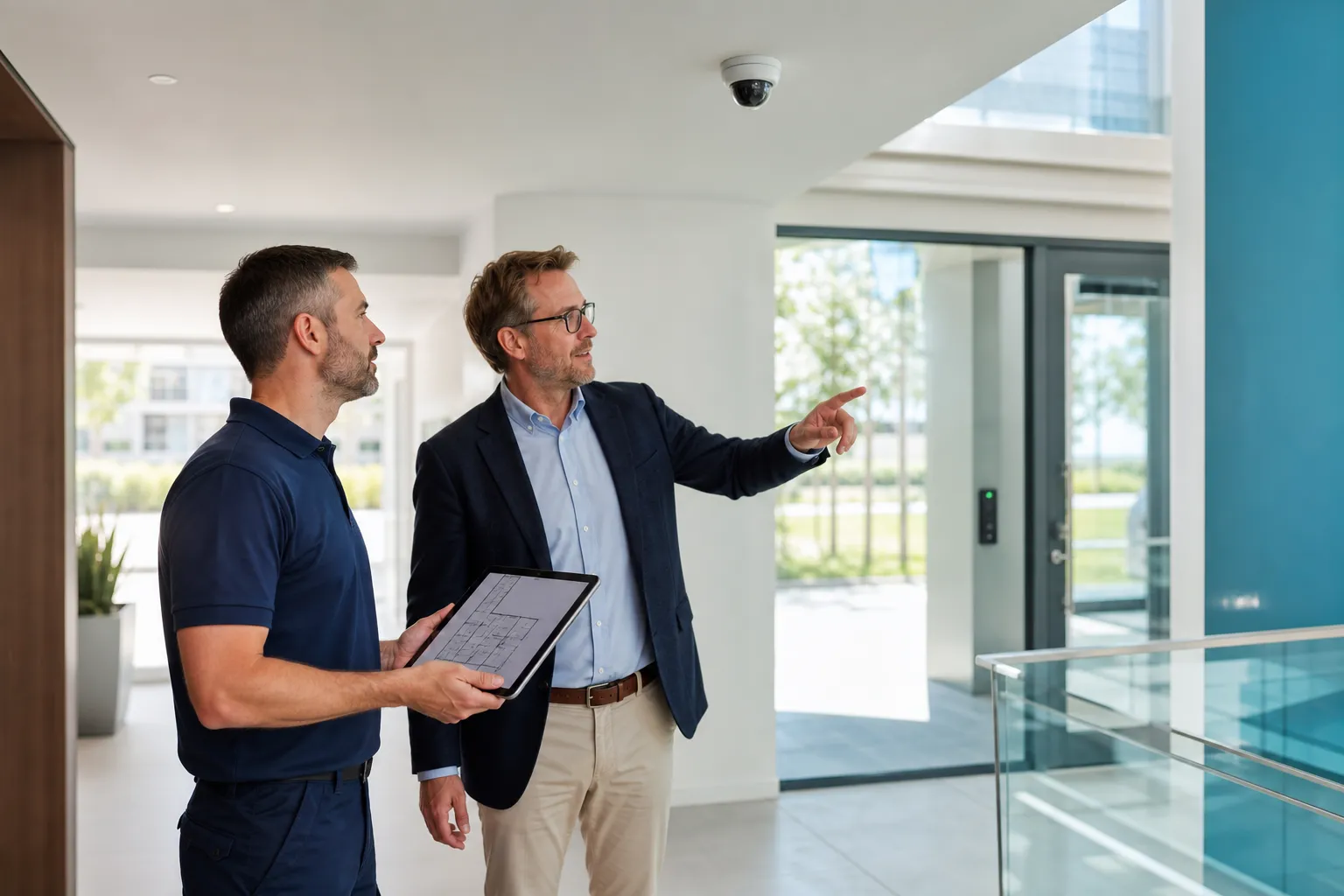
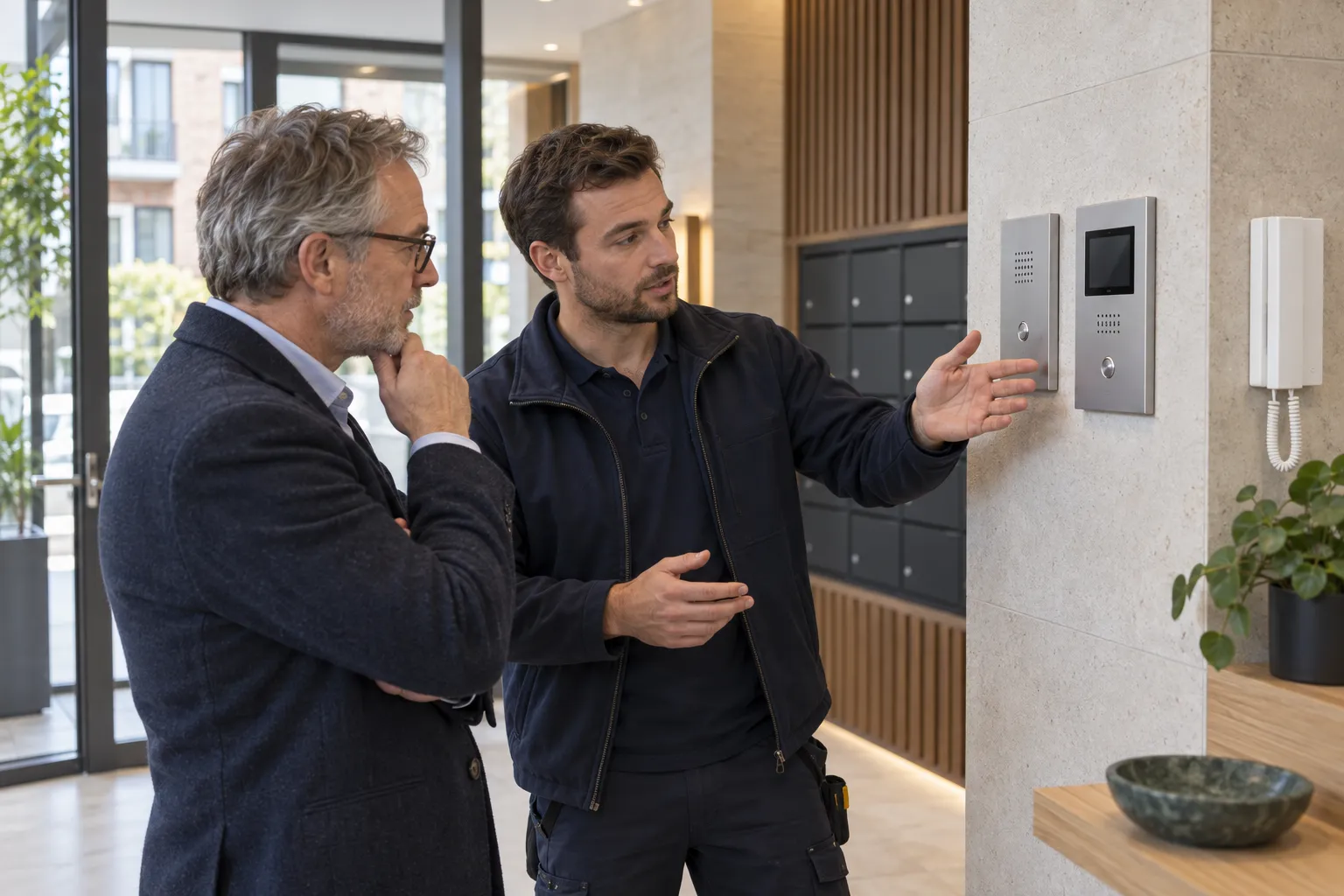
An audio intercom lets visitors speak to occupants; video intercom adds an image. Choice depends on unit count, cabling, door hardware, remote release, call routing and recording. Diagnose the existing system before promising reuse.
Key points
- Audio is enough where voice identification meets the need.
- Video helps identification but adds privacy questions.
- Power, lock, cabling and programming belong to the system.
- Shared-building topology matters more than the monitor model.
The terminology
Audio intercom provides voice and optional door release. Video intercom adds a camera and screen or app.
Wireless does not mean power-free. An apartment system may use fixed risers even when calls reach a smartphone.
| Solution | Function | Common use |
|---|---|---|
| Audio intercom | Voice | Simple entry |
| Video intercom | Voice and image | Visual identification |
| IP intercom | Network calls | Business |
| Multi-resident | Many homes | Apartment building |
Forgotten components
Entrance panel, power, cable, indoor unit, lock interface and programming form one system.
A fault may come from power or the release rather than the screen. Diagnosis avoids replacing the wrong part.
- Entrance panel
- Power
- Cable or network
- Indoor units
- Lock
- Programming
Audio or video
Audio suits a nearby, well-lit entrance. Video helps at distance, gates or reception.
Check angle, backlight and height. A very wide view may record more than necessary.
- Distance
- Lighting
- Station count
- Accessibility
- Mobile answer
Two-wire, existing cabling or IP
Two-wire may allow reuse, but not every cable or topology is compatible. Test quality and branches.
IP supports business routing but needs network segmentation, power and management. In renovation, network cable to the gate preserves options.
| Architecture | Strength | Check |
|---|---|---|
| Two-wire | Possible reuse | Topology |
| Existing multi-core | May be useful | Measurement |
| IP | Network integration | VLAN and power |
| Radio/mobile | Flexible | Range and dependencies |
Home, apartment building and business
A home can ring several stations with a local fallback. A building needs names, flats, risers and coordinated access.
A business can route calls by time to reception or a team. Define overflow and unanswered calls.
- Calls
- Schedules
- Names
- Fallback
- Administration
Video intercom and camera law
The DPA treats a visible doorbell device without recording differently from recorded surveillance. Recording and surveillance purpose change the analysis.
Do not enable continuous recording without a defined need. Review cloud suppliers and terms too.
- Visible device
- At the doorbell
- Recording
- Limited view
- Cloud provider
Access control and release
Intercom handles visitors; access control handles known users. Both can operate one door.
Exit, power-loss and gate safety remain essential.
- Visitor versus user
- Compatible lock
- Safe exit
- Power loss
- Gate movement
The technical survey
Inventory the panel, power, indoor units, doors and drawings. Test cabling and lock separately.
The quote should state reuse, replacement, exclusions, testing and phasing.
- Inventory
- Cable test
- Lock test
- Call scenario
- Phasing
- Training
FAQ
Are audio intercom and door phone the same?
They generally describe voice communication at the entrance.
Can calls go to a smartphone?
Yes on some systems; check internet dependency, accounts and subscriptions.
Can old cabling be kept?
Sometimes, after topology and condition testing.
Must video intercom be declared as a camera?
It depends on visibility, recording and surveillance use.